 Singing Start Guide
If the sticking point is structure rather than money, Singorama hands you 28 audio modules and 120+ warm-up tracks in a fixed order for one payment of around $67 at the time of writing, with 60 days to ask for it back.
See what’s inside →Affiliate link: we may earn a commission if you buy through this button, at no extra cost to you. How we are funded.
The singing lessons vs apps question usually gets answered with “lessons are better, obviously”, and that is only true if you can afford them weekly and actually book them. Throw YouTube into the comparison and the picture changes again, because free instruction is genuinely excellent at some jobs and hopeless at others. Here is what each of the three actually delivers on cost, feedback, structure and accountability, and which combination makes sense at which stage.
The Short Answer
A private teacher is the only option that gives you real diagnosis: someone who can hear that you are flat on descending phrases because your jaw locks, and can fix it in one session. Apps are the only option that gives you objective pitch feedback every single day for the price of a couple of coffees a month. YouTube is the only option that costs nothing and covers every topic ever discussed, and it is the only one with no idea who you are, what you did yesterday, or what you should do next.
Most beginners are best served by a paid structure plus daily pitch feedback, with occasional lessons bought as audits rather than as a weekly commitment.
Cost: What You Actually Pay
One private hour with a good local teacher typically costs more than a full year of most singing apps, and rates vary enormously by city and by the teacher’s experience, so get quotes locally rather than trusting any number you read online. We break the variables down in our guide to what singing lessons cost.
Apps run on subscriptions, usually with a free tier that is a genuine sampler rather than a trick. One-off courses sit in between: a single payment, yours forever, no recurring charge to forget about. YouTube costs nothing but your time, and the time cost is real, since finding the right video and working out whether the person in it knows what they are talking about can eat as much of your week as the practice does.
Feedback: The Thing That Actually Separates Them
There are three different things people call feedback, and mixing them up is why this debate goes in circles.
- Measurement tells you that you sang a flat note. An app does this brilliantly, instantly, and every day.
- Diagnosis tells you why you sang a flat note. Only a human who can see and hear you does this reliably. No app currently comes close.
- Prescription tells you what to do about it for the next six weeks. A teacher does this best; a well-built course does it adequately; YouTube does not do it at all.
That is the real hierarchy. It is also why buying one lesson every couple of months while practising with an app daily works so much better than the price difference suggests: you are buying the diagnosis, which is the expensive part, and getting the measurement cheaply elsewhere. Our guide to teaching yourself to sing goes deeper into patching those gaps.
Structure: Who Decides What You Do Today
YouTube’s weakness is not quality, it is sequencing. There are thousands of excellent beginner videos and almost no lesson fourteens, because the algorithm rewards the introduction and not the follow-through. You end up with a playlist of first steps and a vague sense that you have covered everything.
Courses and subscriptions fix that by making the order somebody else’s problem. Apps sit in the middle: the good ones have a path, but the path is usually built around pitch games rather than technique, so you can get very good at the app and only moderately better at singing.
The Three-Way Comparison
| Criterion | Private lessons | Apps and courses | YouTube |
|---|---|---|---|
| Cost | Highest by a wide margin, per hour | Low; subscription or one payment | Free |
| Feedback quality | Diagnosis and prescription, tailored | Accurate measurement, no diagnosis | None whatsoever |
| Structure | Excellent, adapted to you weekly | Good; fixed path you follow in order | Poor; endless lesson ones |
| Flexibility | Fixed appointments, travel or video call | Any time, any length, on your phone | Total, which is part of the problem |
| Accountability | Strong; someone is expecting you | Moderate; streaks and progress screens | Almost none |
| Best for | Deadlines, plateaus, suspected strain | Daily practice and pitch accuracy | Answering one specific question |
Who Each One Suits
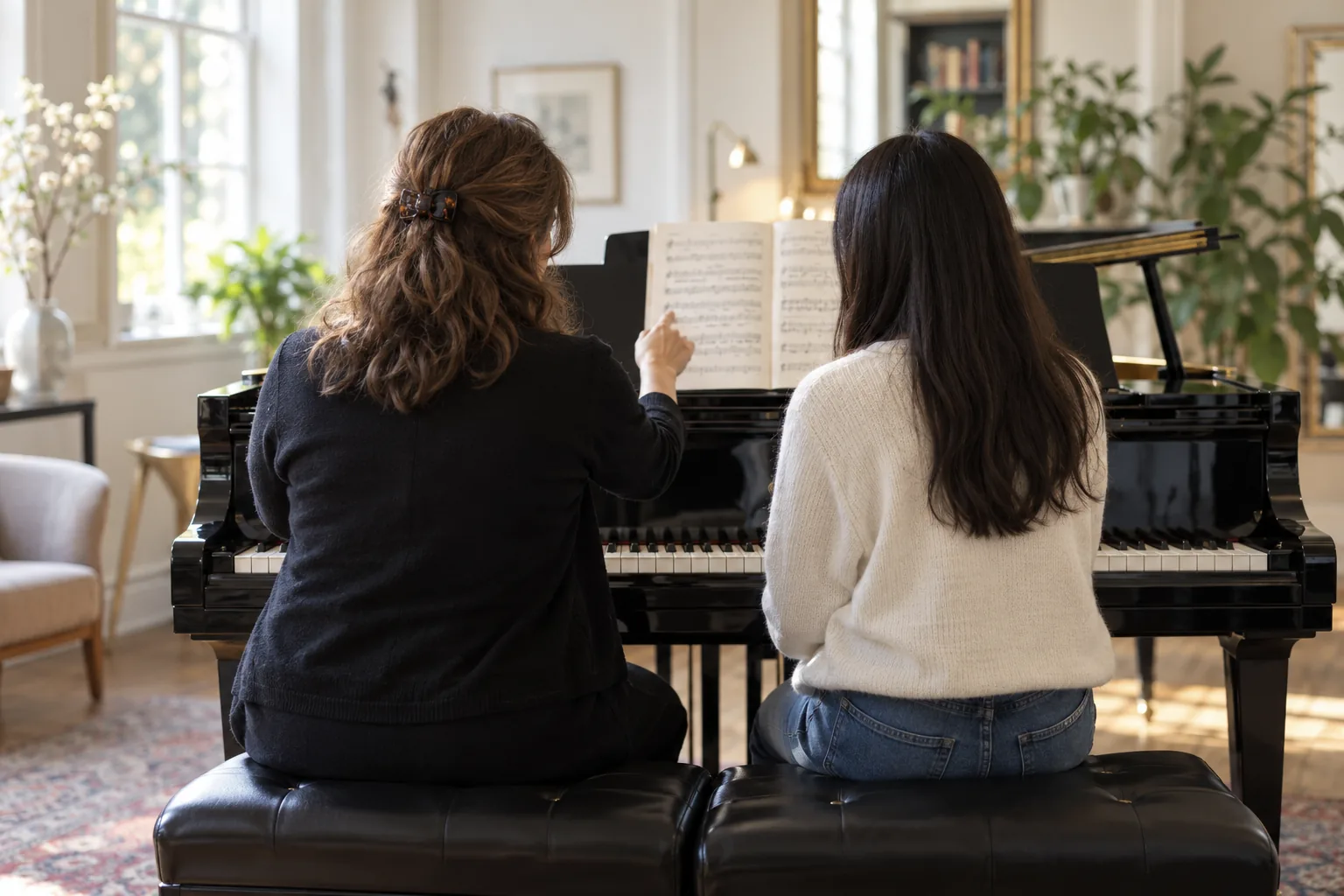
Pick a private teacher if you have an audition, a wedding or a gig on a date; if you have been practising for six months and stopped improving; or if your voice keeps ending up hoarse, in which case getting the technique looked at is not optional. Video lessons count, and widen your choice of teacher enormously.
Pick an app or a course if your problem is consistency and sequencing rather than money, which describes most beginners. Subscription platforms with real coaches on video sit closest to lessons in feel; our 30 Day Singer review covers how that model plays out over a few weeks, and the best singing apps round-up sorts the pitch-scoring options by what they actually measure.
Use YouTube the way you would use a reference book: to answer a specific question you already know you have. “Why does my voice crack on the same note” is a good search. “Learn to sing” is not.
The Combination Most Beginners Should Run
- One structured course or subscription as the backbone, followed in the order it was written, not cherry-picked.
- A pitch-scoring app for daily accuracy work, five minutes inside every session.
- YouTube for specific questions only, capped at one video per problem.
- One paid lesson every six to eight weeks, treated as an audit. Bring a recording and a list of what is not working.
That combination costs a fraction of weekly lessons and covers measurement, diagnosis, prescription and structure between them. If you would rather see the paid options side by side first, our comparison of the best online singing lessons lays out where each one lands.
On the course side, the option we keep coming back to for beginners who want to own their material rather than rent it is Singorama. You get 28 audio modules in a fixed order, a large library of warm-up and technique tracks through the Advancement App, a mini recording studio with a virtual keyboard for scale work, and a guide to reading music, for one payment of around $67 at the time of writing against the vendor’s own claimed 7 value, with a 60-day money-back guarantee. Be clear-eyed about what it is not: the sales page and branding look dated, it is audio-and-ebook led rather than slick modern video, nothing in it listens to your voice, and the upsells after checkout are pushy, including a Platinum Inner Circle membership sold separately at a price we could not verify. Our full Singorama review goes through all of that in detail before you spend anything.
Frequently Asked Questions
Can singing apps replace a teacher completely?
Not completely. They measure pitch better than your ears can and they will keep you practising, but none of them can see your jaw clench or hear why a phrase collapses. For most beginners that gap does not matter for the first several months, and then it starts to.
Is YouTube good enough to learn singing from scratch?
It is good enough for information and bad at ordering it. People do succeed with it, and the ones who do usually impose their own structure and record themselves obsessively. If you are not that person, pay for a path.
How often should I take real lessons if I mostly use an app?
Every six to eight weeks is the sweet spot for most self-directed beginners. Frequent enough to catch habits before they set, infrequent enough that the cost stays sensible. Arrive with a recording so the teacher is not spending your money working out what you sound like.
Are one-off courses better value than subscriptions?
They are if you finish them. A single payment removes the monthly drip and the guilt of an unused subscription, but a course you abandon in week two is worse value than three months of something you actually open. Judge yourself honestly on that before choosing.
What to Read Next
- The best online singing lessons, compared on price, structure and feedback.
- What singing lessons cost, before you book anything locally.
- Can you teach yourself to sing?, and how to cover the blind spots.
- More options in the how to learn singing section.
⚠️ Affiliate disclosure: some links in this article are affiliate links. If you buy through them we may earn a small commission at no extra cost to you — it never changes what we recommend. Read our full disclosure.