 Singing Start Guide
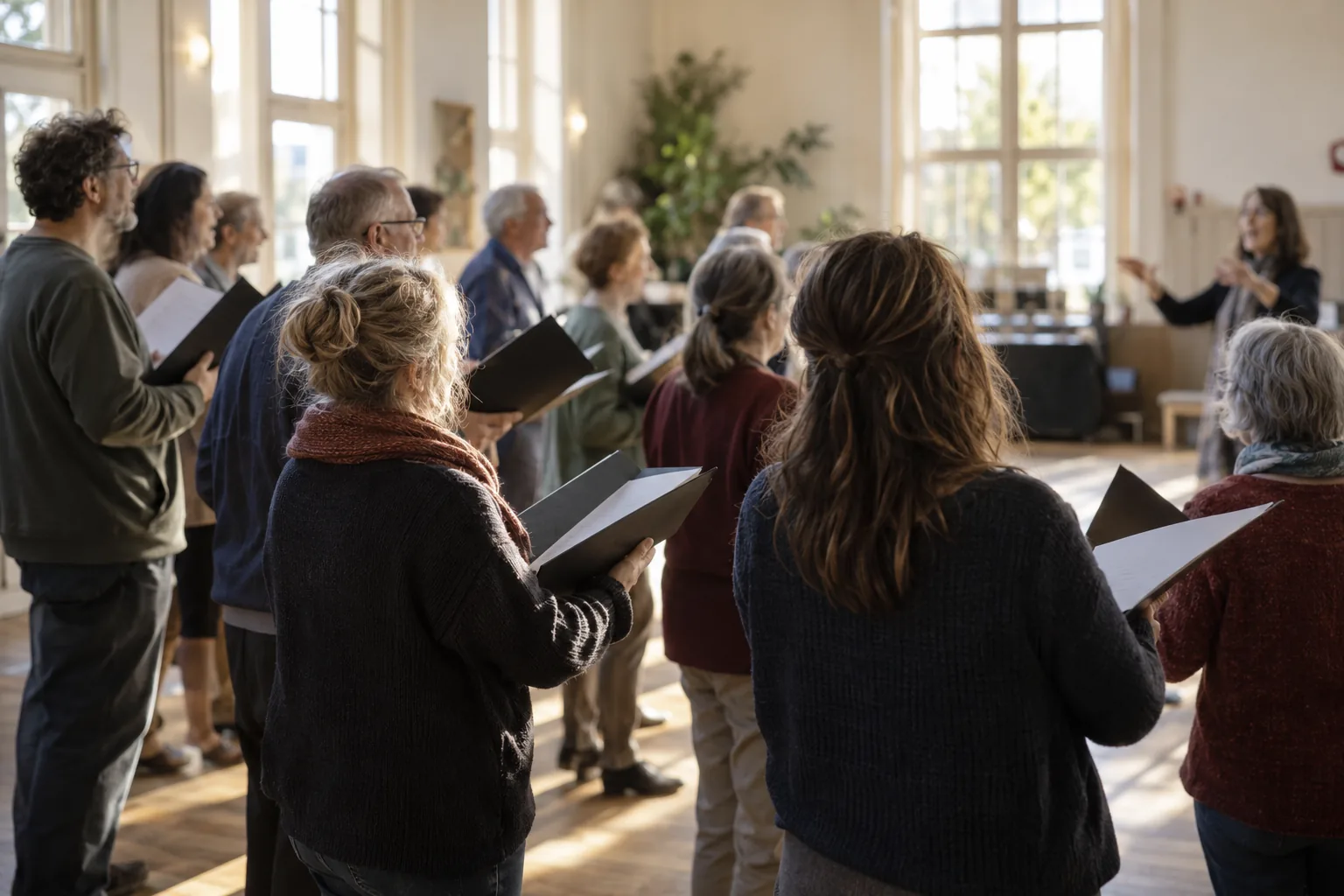
Learning to sing as an adult carries a quiet assumption with it: that you have missed the window, and whatever you build now will be a lesser version of what a child would have got. That assumption is mostly wrong. Adults learn some parts of singing faster than children do, and the parts that are genuinely harder are not the physical ones. The obstacle for most adult beginners is not their larynx. It is the feeling of being bad at something in front of other people, at an age when you are used to being competent.
What adults are actually better at
Start with the good news, because it rarely gets said.
- You can follow an explanation. Tell a child to keep the ribs open while the abdominal wall gradually releases and you will get a blank look. An adult can understand the mechanism, notice when they are not doing it, and self-correct.
- You practise deliberately. Adults can work on one bar for ten minutes because they understand why. Children usually cannot, which is why child lessons involve so many games.
- You chose this. Nobody made you. Motivation from inside is worth an enormous amount over a two-year timescale.
- Your instrument is finished. An adult voice is stable. A teenage voice is a moving target, and technique built on it has to be rebuilt.
- You have life in your voice. This sounds like a platitude and it is a real thing. Interpretation, phrasing and emotional delivery come more easily to someone who has lived a bit.
The obstacles that are real
Self-consciousness. This is the big one, and it is not a personality flaw. Your singing voice is more exposed than any instrument, because it is you, and being bad at it feels personal in a way that being bad at chess does not. Adults also carry specific memories: a music teacher who told them to mouth the words, a sibling who laughed. Those memories cause physical tension, which restricts your voice, which makes you sound worse, which confirms the story. Breaking that loop matters more than any technical work.
Ingrained speech habits. Thirty or forty years of a particular way of holding your jaw and using your breath takes longer to change than three years does. This is genuinely slower for adults. It is not a barrier, just a longer runway.
Impatience. Adults are used to being competent, and beginner incompetence is uncomfortable. A lot of adult learners quit at around week six, which is exactly when the first real changes start to be measurable but before they are audible to the person making them.
Time and privacy. Children get scheduled lessons and a parent who insists. Adults have jobs, thin walls, and housemates. This is a logistics problem, and logistics problems have solutions.
Dealing with the embarrassment
Practical things that work, rather than being told to believe in yourself.
Practise where nobody can hear you, at least for the first two months. Car parks, a house with everyone out, headphones with a backing track. The point is not hiding forever, it is removing the tension while you build the coordination. You can reintroduce an audience later.
Record yourself early and often, and get the shock over with. Almost everyone hates their recorded voice the first time. That reaction fades with exposure, and once it does you have gained the single most useful feedback tool available to a self-taught singer.
Do the ugly exercises. Lip trills, witch cackles, whiny “nay nay nay”. They sound ridiculous by design, which paradoxically makes them easier for a self-conscious adult than trying to sound beautiful and failing. Our list of vocal warm-ups for beginners is full of them.
If it is available to you, a choir is remarkably effective medicine. Twenty other voices around you means nobody can pick yours out, which removes the exposure while still giving you the experience of singing with people.
What to expect, month by month
Rough shape for an adult beginner doing 20 to 30 minutes, five days a week.
- Month 1. Everything is awkward. You learn what the exercises are and your voice feels less reliable, not more, because you are noticing problems that were always there.
- Months 2 to 3. Breath control improves noticeably. Phrases that used to run out now finish. Pitch accuracy on simple melodies gets more consistent.
- Months 4 to 6. The register transition starts smoothing. Your usable range grows at both ends. Recordings from month one start sounding like a different person.
- Months 7 to 12. You can sing a handful of songs reliably rather than hopefully. Tone develops. This is where most people would say they can sing.
That is a normal trajectory, not a fast one. For a fuller treatment of the timeline, including what the two-year picture looks like, see how long it takes to learn singing. And if the underlying worry is whether you have any natural ability at all, can anyone learn to sing deals with that question directly.
🎸 Also picking up an instrument?
Our sister site Guitar Start Guide gives the same honest, beginner-first guidance for guitar — and Piano Start Guide does it for piano.
Setting expectations that survive contact with reality
Be honest with yourself about the goal. “I want to sing three songs well enough to enjoy singing them at a party” is achievable inside a year for almost anyone. “I want to sound like the singer on the record” is not a goal, it is a comparison, and it will make you miserable, partly because that record has been comped from twenty takes and tuned.
The specific thing I would do if I were starting at forty-five: pick two songs you actually love, in keys that suit you, and make them your only repertoire for three months. Not a rotating playlist. Two songs. Record both on day one, put the file somewhere you will not delete it, and do not listen to it again until month three. Adults quit because progress is invisible on a weekly scale, and that one buried recording is the cheapest insurance against quitting that exists.
The first practical step, if you have not taken it yet, is laid out in how to start singing.
Frequently Asked Questions
Am I too old to learn to sing?
No. Voices change with age, but the capacity to learn technique does not disappear, and people take up singing successfully in their sixties and seventies. What changes is that recovery from heavy sessions takes a bit longer, so short and frequent practice matters more, not less.
Does an adult voice change as you get older?
Gradually, yes. Tissue elasticity and muscle mass shift over decades, which can narrow the range slightly and affect vibrato. Regular healthy use offsets a fair amount of this. Many singers find their voice at fifty is warmer and more interesting than it was at twenty, even if the top two notes have gone.
I was told as a child that I could not sing. Is that permanent?
Almost never. Genuine congenital tone deafness affects a very small minority of people. Far more common is a child who was never taught to match pitch, was told they were hopeless, and then stopped practising the one thing that would have fixed it. Pitch matching is a trainable skill at any age.
Should adults start with lessons or self-study?
Either works. Self-study suits adults who are self-motivated and want to avoid the exposure of singing in front of someone in week one. Lessons suit people who need accountability or who are already frustrated. A common middle route is a couple of months of self-study followed by a few lessons as a check.
Adults often prefer to pay once rather than subscribe. Our Singorama review and Singorama cost pages cover one such course, and best online singing lessons compares the rest.
What to Read Next
- Can anyone learn to sing? for the ability question.
- How to start singing, the first week.
- How long it takes to learn singing.
- More in How to Learn Singing.