 Singing Start Guide
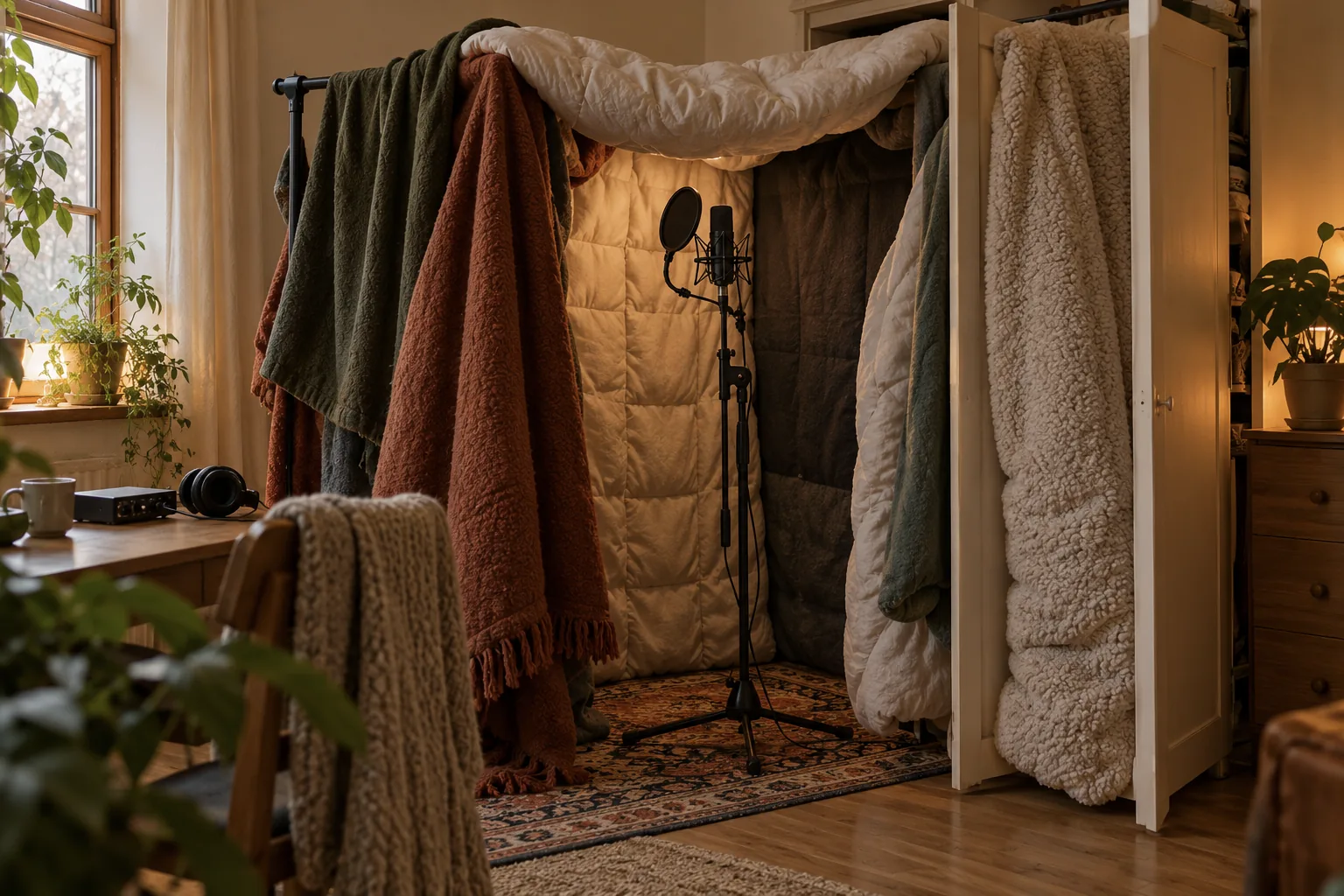
Getting the room out of the way exposes the voice completely, which is a good thing only if the voice is ready for it. Singorama’s audio modules are how you get it ready.
Affiliate link: we earn a commission if you buy, at no extra cost to you.
See what’s inside →A home vocal booth is not a soundproof box. That distinction is the reason most DIY booth projects disappoint their builders. Soundproofing keeps noise from getting out or in, and it requires mass, sealed gaps and building work. What a singer actually needs is acoustic treatment: stopping their own voice bouncing off hard surfaces and arriving back at the microphone a few milliseconds late. The second job is easy and cheap. The first is not, and no amount of duvets will do it.
Once you accept you are building a reflection trap rather than a sound-blocking chamber, the whole project gets simpler and the results get better. There are no shop links here, and most of what follows costs nothing anyway.
What actually reduces reflections
Absorption depends on thickness and density. Sound at speech and singing frequencies passes straight through thin materials and gets absorbed by thick, fibrous, heavy ones. That single principle explains why some famous DIY tricks work and others do not.
- A thick duvet, hung with air behind it. Genuinely effective. The thickness absorbs, and the air gap behind it improves absorption at lower frequencies. This is the single best free tool you have.
- An open wardrobe full of hanging clothes. Excellent, because densely packed fabric with irregular surfaces is close to an ideal absorber. Sing into the clothes, not out of the wardrobe.
- Heavy curtains, gathered rather than flat. Gathering roughly doubles the effective material in the same width and works noticeably better than a taut sheet.
- A mattress leaned against a wall. Awkward and antisocial, but very effective, which is why it keeps appearing in the studios of people with no money.
- Thick rugs and a full bookcase. The rug kills the floor bounce, the bookcase scatters rather than absorbs, and scattering is the next best thing.
What is a myth
| Popular trick | Does it work? | Why |
|---|---|---|
| Egg boxes on the wall | No | Too thin to absorb, too regular to scatter usefully |
| Four thin foam tiles behind the mic | Barely | Absorbs highs only; leaves the boxiness untouched |
| Duvet hung flat against a wall | Partly | Works, but far better with an air gap behind it |
| Singing inside a small sealed cupboard | Often worse | Small hard-walled spaces create their own boxy resonance |
| Blankets over the microphone itself | No | Muffles the mic rather than treating the room |
| Open wardrobe of clothes | Yes | Thick, dense, irregular fabric absorbs broadly |
| Thick duvet with air gap behind | Yes | Mass plus gap absorbs across a wide range |
| Corner of the room as a booth | Depends | Bad if bare, good once both walls are covered |
Three booths you can build this afternoon
The wardrobe. Open the doors, push the clothes to fill the width, put the microphone just inside the opening pointing into the clothes, and stand outside singing in. Ten seconds to set up, nothing to buy, and it beats most foam-tile installations comfortably. Push a coat or two behind your head if the doors do not shield you.
The duvet corner. Take a room corner, hang a thick duvet across it diagonally to make a triangle, leaving a hand’s width of air between duvet and wall. Stand inside facing out, microphone in front of you, duvet behind your head. The corner deals with two walls at once and the duvet handles the reflection path behind you, which is the one that does most of the damage.
The doorway. Hang a duvet over an open door frame and sing with the microphone on the treated side. Cheap, easily dismantled before anyone comes home, and effective because it removes the largest flat reflective surface in front of you.
Where the microphone goes
Position matters as much as material. Three rules cover it.
- Never in the exact centre of a room, and never exactly halfway between two parallel walls. Those are the worst spots acoustically and, unhelpfully, the ones people instinctively choose.
- Absorption goes behind the singer first, then behind the microphone. Most beginners cover the wall they are facing and leave the one that actually matters bare.
- Keep the microphone away from hard surfaces, including the desk. A reflection off a wooden desktop arriving a millisecond late causes a hollow, comb-filtered tone that is difficult to diagnose and easy to prevent.
The comfort problem nobody mentions
Duvet forts get hot, airless and dark within about ten minutes. That matters more for a singer than for a podcaster, because hot stuffy air dries your throat and a cramped posture closes your ribcage. If you cannot stand up straight, breathe freely and open your mouth fully inside your booth, the booth is costing you more in performance than it is gaining you in acoustics. Everything in our guide to breath support assumes you have room to expand.
Take the duvet down between takes, keep water nearby, and stop if your voice starts feeling dry or scratchy rather than pushing on. Our notes on the signs of vocal strain apply exactly as much in a homemade booth as anywhere else, and the stuffy air makes them more likely rather than less.
What we would build, and when to stop
Use the wardrobe. It takes ten seconds, costs nothing, dismantles itself, and gets you roughly eighty percent of what an amateur booth can achieve. Record a test take before and after and listen to the two back to back; the difference is usually obvious enough that you will stop wanting to spend money on foam. Beyond that, resist the temptation to keep building. A treated corner is a solved problem, whereas tone, breath and pitch are not, and those are what a listener actually notices. Structured technique material such as Singorama’s audio modules is the better next investment once your room stops embarrassing you.
Frequently Asked Questions
Will a home vocal booth stop my neighbours hearing me?
No. Blocking sound requires mass and sealed air gaps, which means walls, doors and construction, not soft furnishings. A duvet booth reduces reflections inside the room and does essentially nothing to what travels through the wall. Sing at sensible hours instead.
Is a wardrobe really good enough?
For a home recording, yes. Hanging clothes are dense, thick and irregular, which is close to what a purpose-built absorber is trying to be. Point the microphone into the clothes rather than out into the room and you have a genuinely decent recording position.
Do I need a reflection filter behind the microphone?
They help a little and are frequently oversold. A reflection filter treats a small area immediately around the capsule while leaving the rest of the room untouched. A duvet behind the singer usually does more for less, which is why we put it earlier in the list.
Should I use a dynamic or condenser microphone in a DIY booth?
Dynamic, until the treatment is genuinely working. A dynamic microphone rejects most of what happens more than a foot away, which does some of the booth’s job for you. Once a corner is properly covered, a condenser starts to reward you rather than punish you. Our gear section covers the choice in more depth.
What to Read Next
- All our recording and gear guides
- Warm-ups to do before a session
- Signs of vocal strain to watch for
- A practice routine worth recording
⚠️ Affiliate disclosure: some links in this article are affiliate links. If you buy through them we may earn a small commission at no extra cost to you — it never changes what we recommend. Read our full disclosure.