 Singing Start Guide
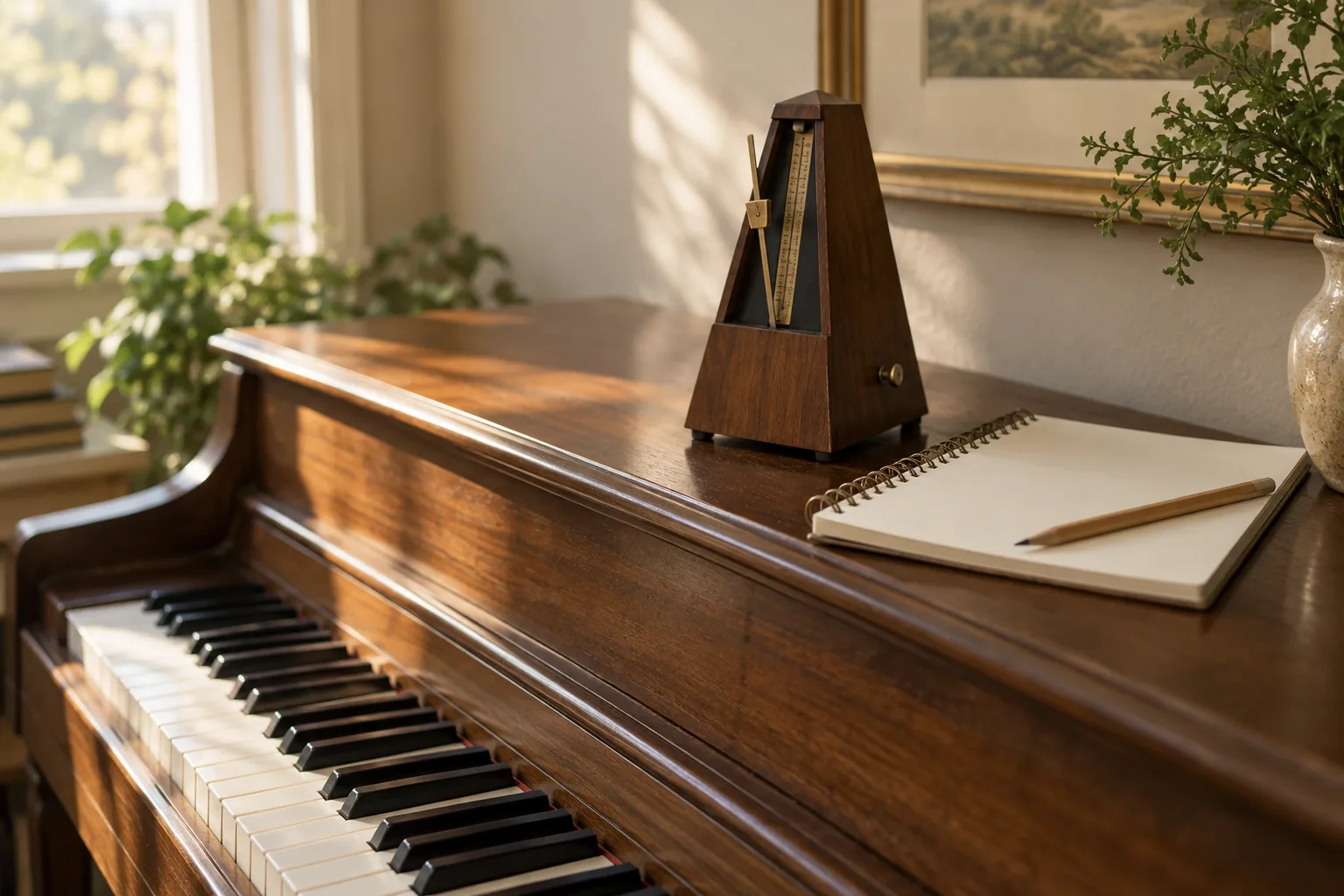
Ask a band which member is most likely to have shaky time and you will get the same answer with depressing regularity. Rhythm basics for singers get skipped because singing feels like an emotional activity rather than a mechanical one, and because nothing about producing a note is physically tied to the beat. A drummer’s hand moves. A guitarist’s arm strums. A singer can drift for four bars without anything in their body telling them.
The structural disadvantage singers have
Every other musician has a physical action attached to time. That action provides constant feedback. Singers have breath, which is slower and less precise, and a sound that starts inside the head where it is heard early and loudly. The result is that a singer can be ten milliseconds ahead of the band all night and be the only person in the room who cannot hear it.
The good news is that this is a mechanical problem with a mechanical fix. Nobody has bad rhythm as a permanent trait. They have an untrained internal clock, and clocks respond very well to training.
Counting, in the smallest useful amount
Music is divided into bars, and each bar contains a fixed number of beats. Most popular music has four. Waltzes and some folk music have three. That is genuinely most of what you need, and you can hear the difference by counting along with a recording until the count keeps landing on the strong beat.
The strong beat is beat one, where the harmony usually changes and where the bass tends to land. Find that and everything else has a reference point. Count out loud with a few songs on your playlist this week, four beats over and over, and notice how often your count and the music disagree. That disagreement is the thing you are fixing.
Subdivision does the real work
Counting beats keeps you roughly in the right bar. Subdividing, which means splitting each beat into smaller equal parts, is what makes you accurate to within a fraction of a beat. Almost every timing error a beginner makes is a subdivision error dressed up as something else.
| Level | How to count it out loud | What it fixes | Where you will need it |
|---|---|---|---|
| Beats only | One, two, three, four | Getting lost in the bar | Slow ballads, following a chart |
| Eighths (halves of a beat) | One and two and three and four and | Rushing the second half of a long note | Most pop and rock phrasing |
| Sixteenths (quarters of a beat) | One e and a, two e and a | Sloppy fast passages and unclear consonants | Funk, R&B, anything syncopated |
| Triplets (thirds of a beat) | One trip let, two trip let | Flattening a shuffle into something square | Blues, swing, gospel, a lot of soul |
Try this once and it will convince you: take a phrase you always rush and count eighths out loud through it before singing. Then sing it while keeping the eighths running silently in your head. The difference is usually immediate and slightly humbling.
Why singers rush
- Adrenaline. Under pressure your internal clock speeds up while the band’s does not. Everything feels slow, so you push.
- Breath anxiety. If you are worried about running out of air you unconsciously start the phrase early to buy yourself time.
- Treating rests as gaps. Silence is written music too. Singers who stop counting during rests come back in wherever feels right.
- Cutting long notes short. Holding a note for four full beats is boring and slightly uncomfortable, so most people release on three and a half.
- Reading ahead. Eyes moving to the next line pulls the voice with them.
Notice that two of these are breath problems wearing a rhythm costume. If you consistently rush at the end of long phrases, the fix is better breath management rather than more counting.
Entries: the moment everything is decided
An entry is judged in the instant it happens, and a late or early start colours everything after it. The technique is simple and almost nobody does it: count the bar immediately before your entry, silently and completely, including the subdivisions.
Watch for pickups, where the phrase starts before beat one rather than on it. A huge number of songs begin with a syllable or two that belong to the previous bar. If you have ever come in a beat late on a song you know perfectly, that is almost certainly why. Breathe on the beat before your pickup, every time, and make the breath part of the rhythm rather than an interruption to it.
Holds: ending on the right beat
Releases matter as much as attacks and get about a tenth of the attention. A note written for four beats should end at the start of beat five, not somewhere in the middle of beat four because you got bored. In a group this is even more visible: a choir where everyone releases at a slightly different moment sounds ragged even if the singing was excellent.
Practise by counting the release out loud. Sing the note, count “two, three, four” underneath it, and cut on the imaginary “one”. It feels pedantic for about a week and then becomes automatic.
Four drills that actually work
- Metronome on 2 and 4. Set it to half your tempo and treat the clicks as the backbeat rather than beat one. Suddenly you have to keep time yourself, and drift becomes obvious.
- Clap the vocal line. Before singing a new song, clap its rhythm from start to finish. If you cannot clap it, you cannot sing it accurately.
- Speak the words in tempo. No pitch, just words against a click. This catches every awkward corner in a fraction of the time.
- Record and check against the click. Listening back with the metronome audible in the recording is uncomfortable and extremely effective.
Five minutes of this at the start of a session is enough. Slot it into your regular practice routine immediately after warm-ups, while your attention is fresh, rather than at the end when you are tired and inclined to skip it.
Rhythm is also expression
Once your time is solid, deliberately playing with it becomes an option. Singing slightly behind the beat sounds relaxed and confident; slightly ahead sounds urgent. Almost every singer you admire does this constantly, and it only reads as style when the underlying time is accurate. Done by accident, the same thing just sounds wrong.
That is the argument for doing the boring counting work: it is what buys you the right to ignore it later. Apply it to something simple first, such as anything from our easy songs to sing list, before trying it on material that is already stretching you technically. The broader picture of what to work on and when sits in how to sing better.
An unexpectedly good use for a lesson app: most singing software scores pitch and treats timing as an afterthought, but the gamified music apps built around playing along with a track are ruthless about when you come in and when you stop. Yousician’s vocals path is one of the few that gives a beginner honest, immediate feedback on timing rather than only on notes, and our Yousician singing review covers how much of that you get on the free tier and where the format falls short for voice specifically.
Frequently Asked Questions
Can you fix bad rhythm, or is it something you are born with?
It is trainable, and usually faster than pitch. Timing is a motor skill built on prediction, and prediction improves with repetition. Most people who describe themselves as having no rhythm have simply never counted out loud with music, which sorts a surprising amount of it within a few weeks.
Should I always practise with a metronome?
Not always, but regularly. A metronome is a diagnostic tool rather than a musical partner. Use it to find where you drift, then switch it off and see whether the fix holds. Practising exclusively with a click can make your phrasing rigid, which is its own problem.
Why do I speed up when I get emotional in a song?
Because intensity and tempo are linked in the body, and a rising heart rate drags your internal clock with it. Professionals feel exactly the same pull and simply have a stronger reference. Counting subdivisions through the intense sections is the practical countermeasure.
Do I need to read rhythmic notation?
Only if you work from written music. What you do need is the ability to hear and reproduce subdivisions, which is a separate skill from reading them. Plenty of excellent singers have flawless time and cannot read a bar of notation.
What to Read Next
- A beginner practice routine to slot five minutes of counting into.
- Breath support for singing, which fixes the rushing that counting cannot.
- Our Yousician singing review for app feedback that includes timing.
- Easy songs to sing for material simple enough to focus purely on time.