 Singing Start Guide
Slot number one on any singer’s shopping list is not hardware at all. Singorama’s 28 audio modules plus its practice tools are a $67 one-off on the vendor’s page (checked 30 September 2026).
Affiliate link: we earn a commission if you buy, at no extra cost to you.
See what’s inside →Almost every budget home recording setup guide is written in the wrong order. It starts with the microphone, because that is the exciting bit, and works outward. A singer’s money goes further spent in a completely different sequence, one that front-loads the cheap things that make the largest difference and delays the expensive things that make the smallest. What follows is the minimum viable chain, ordered by what to buy first.
We recommend by category and specification rather than by pointing you at a particular checkout. Where a link does go to a shop it is an affiliate link, so we may earn a small commission at no extra cost to you. The buying order below is the same either way, and step zero still costs nothing.
Step 0: the things you already own
Before spending anything, get the free stage working. A phone with a voice recorder, a pair of wired earbuds, and a corner of a room with soft furnishings in it is a complete recording setup for the purpose of hearing yourself honestly. If you have not been recording yourself weekly with that, no purchase will help, because the bottleneck is the habit rather than the hardware. Wired earbuds specifically, not wireless, because Bluetooth adds a delay that makes singing to a backing track feel like wading.
Step 1: a pop filter
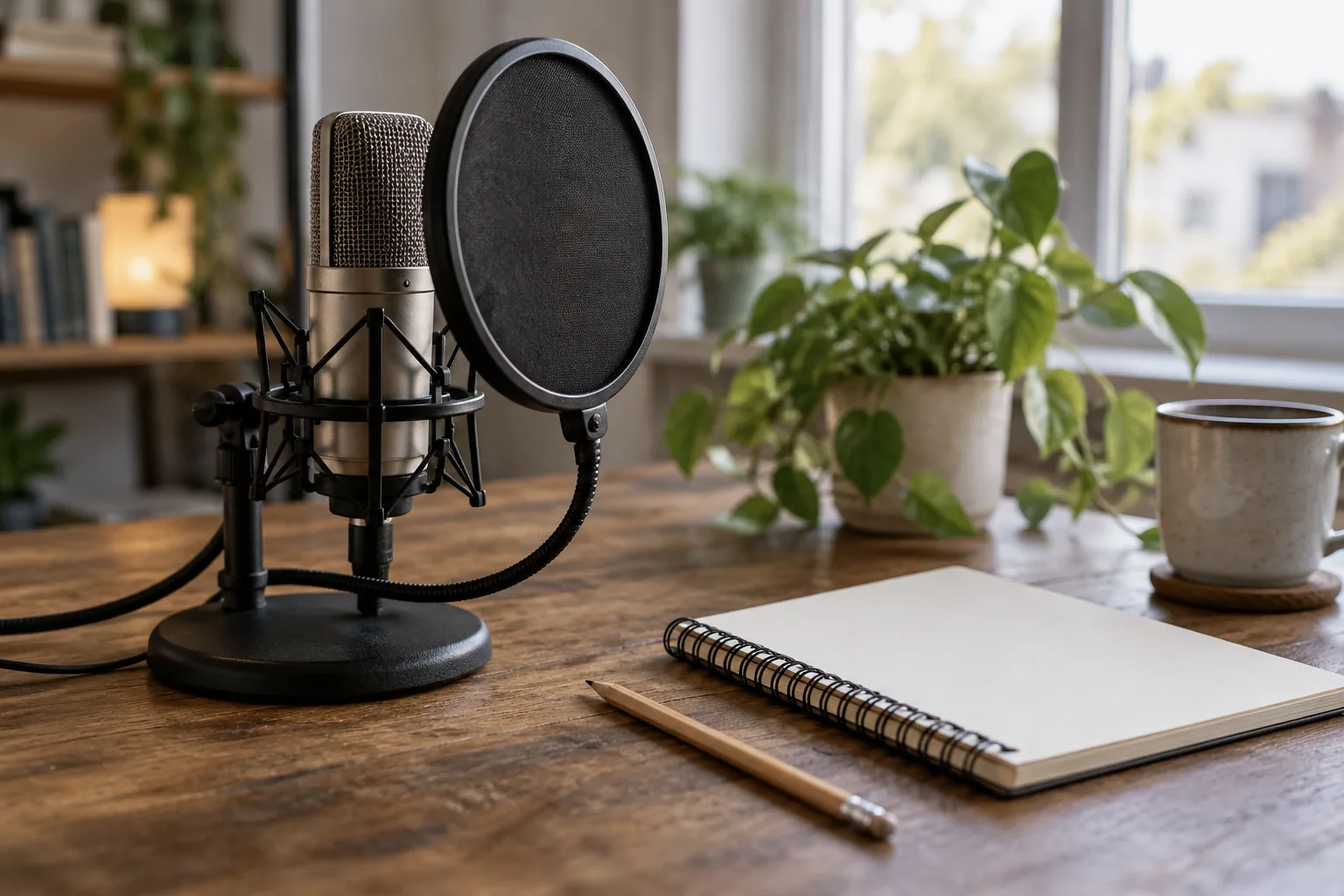
The cheapest item in this entire article and the one with the highest ratio of improvement to cost. Plosive consonants, mostly P and B, push a blast of air at the microphone that arrives as a low thump nothing can remove afterwards. A mesh or foam screen a few inches in front of the capsule stops it. Buy this before the microphone if you enjoy irony, because it will still be useful with whichever microphone you eventually choose.
Browse pop filters on Amazon →
Step 2: soft material behind you
Cost, ideally zero. Your voice travels past the microphone, hits the wall behind you, and returns a few milliseconds later as the boxiness that marks out a bedroom recording. A thick duvet hung on a door frame, a heavy curtain, or an open wardrobe of hanging clothes absorbs most of it. This is the second-largest improvement available to a home singer and it is usually free.
Step 3: the microphone
Now, and not before. For an untreated room, a cardioid dynamic microphone in the entry price bracket is the sensible category, and the version with both USB and XLR outputs is the sensible variant because it works today with a laptop and survives an upgrade later. A condenser is the wrong first choice in a normal bedroom, however often it is recommended, because its extra sensitivity captures the room you have not treated.
Names you will encounter while searching, offered as landmarks rather than as tested recommendations: the classic handheld dynamics used on every stage in the world, and the entry-level hybrid USB and XLR dynamics that several manufacturers make. We have not run them against each other in a controlled test and are not going to pretend otherwise.
Check the current price of the Samson Q2U on Amazon →
Step 4: a stand
Holding a microphone in your hand produces handling noise and, more importantly, stops you standing properly. Singing well needs an open ribcage and a free jaw, and neither survives being hunched over a desk holding a phone. A basic desk stand is enough if you sit; a boom stand is worth it if you stand up to sing, which you should. This connects directly to breath support, and it is the reason a cheap stand outranks an expensive cable.
Browse microphone stands on Amazon →
Step 5 onwards: only if a need appears
Closed-back headphones, an audio interface, a condenser microphone, acoustic panels. Every one of these is a good purchase for someone, and none of them is a good purchase for a beginner who has not yet hit the specific limitation it removes. Wait for the problem, then buy the solution.
The buying order at a glance
| Order | Item | Rough spend | What it fixes | Skip it if |
|---|---|---|---|---|
| 0 | Phone plus wired earbuds | Nothing | Not hearing yourself back at all | Never skip this |
| 1 | Pop filter | Tiny | Thumping plosives | You only sing into a phone |
| 2 | Duvet or curtain behind you | Nothing | Boxy, hollow room sound | You record in a carpeted, soft room |
| 3 | Entry-bracket dynamic mic, USB and XLR | Entry | Thin, distant phone recordings | Recordings are only for self-review |
| 4 | Microphone stand | Small | Handling noise and bad posture | You already own one |
| 5 | Closed-back headphones | Entry to mid | Backing bleeding into the take | You record without a backing track |
| 6 | Audio interface | Entry | Latency, second input, phantom power | You record one voice over USB |
| 7 | Condenser microphone | Entry to mid | Lack of detail in a treated room | Your room is still untreated |
What to skip entirely as a beginner
- Studio monitors. Expensive, need a treated room to be meaningful, and you will mix on headphones anyway.
- Thin foam tiles in small quantities. They absorb high frequencies only, which makes a room duller without making it better.
- Paid recording software. The free options are genuinely excellent and will outlast your beginner phase.
- Boutique cables. A balanced cable either works or does not.
- Anything sold as making your voice sound professional. That is a description of a skill, not a product.
The setup we would build for a beginner singer
A hybrid USB and XLR dynamic microphone, a pop filter, a basic stand, a duvet hung behind the singing spot, free recording software, and the wired earbuds already in the drawer. That is the entire list, it lands comfortably in the entry price bracket in total, and it will not be the reason your recordings disappoint you. Everything left in the budget should go toward the singing rather than the signal path. A structured course such as Singorama, which is a one-off $67 on the vendor’s page (checked 30 September 2026) rather than a subscription, can sit in that gap; per the vendor it includes a mini recording studio and virtual keyboard for scale work. We have not completed it, so see our Singorama review before buying.
🎸 Also picking up an instrument?
Our sister site Guitar Start Guide gives the same honest, beginner-first guidance for guitar — and Piano Start Guide does it for piano.
Frequently Asked Questions
What is the cheapest usable home setup for a singer?
A phone, wired earbuds and a soft corner of a room, which costs nothing. The first meaningful purchase after that is a pop filter and an entry-bracket dynamic microphone, and that combination handles demos, teacher submissions and social clips perfectly well.
Should I buy gear before I can sing well?
Buy the minimum that lets you hear yourself, then stop. Recording is a diagnostic tool for a beginner, so you need it early, but a better microphone gives you a more detailed picture of the same problems rather than fewer problems. Our guide to singing better is the more productive place to spend attention.
Do I need a computer, or can I record on a phone?
A phone is fine for reference takes and for anything you are sending to a teacher. A computer becomes worthwhile when you want to edit, comp several takes together or record over a backing track with proper monitoring.
How much should the whole setup cost?
Less than people expect and less than a single month of many hobbies. The core three items sit in the entry bracket, and prices move around constantly, so check current listings rather than budgeting from a number in an article. The important discipline is buying in order rather than buying everything at once.
What to Read Next
- The rest of our recording and gear guides
- Breath support and why posture matters
- Building a practice routine
- How to sing better
⚠️ Affiliate disclosure: As an Amazon Associate I earn from qualifying purchases. Some links in this article are affiliate links. If you buy through them we may earn a small commission at no extra cost to you — it never changes what we recommend. Read our full disclosure.